29.01.2026
“It Just Works” vs. Revenue Driven Hospitality Software
Knowing the difference between software that simply works and software that helps make money is now an important skill for hotel managers. Go through this article to understand how the right software can directly impact your hotel’s revenue.
Why the process of setting up your software matters more than its features
Most hotels use hospitality software in one of two ways:
- It works.
- It quietly makes money.
The real difference is usually not the product itself. It often comes down to what you expect, how you set it up, and how it fits into daily hotel routines.
This difference matters more than many hotel managers think. As technology becomes more complex and teams have fewer resources, hotels need systems that deliver value without constant attention. Owners and managers now want technology to boost both revenue and efficiency.
Knowing the difference between software that simply works and software that helps make money is now an important skill for hotel managers.
When hospitality software is expected to “just work”
For many hotels, the primary expectation from technology is reliability:
Wi-Fi should connect without generating support calls.
The in-room TV should turn on quickly and behave predictably.
A tablet should be used because it is accessible, not because it needs explanation.
A guest app might sell a few obvious extras, but no one expects miracles.
This approach is common, and for good reasons.
Hotel teams change frequently. Training time is limited. Seasonal operations bring temporary staff. Systems must survive both peak occupancy and quiet periods without requiring constant supervision.
In this environment, software that depends on a specific employee is not scalable. It becomes fragile, and fragility is a significant risk in hotel operations.
For many properties, especially large hotels or multi-property groups, “it just works” is not a compromise. It is the correct target state.
In practice, this means choosing hotel technology that is easy to use, reliable, and clear, so staff need little training, and the system does not depend on a single person or constant tweaks.
For guests, technology should stay in the background. They notice when things go wrong, but rarely mention it when everything works smoothly.
This baseline expectation is foundational. Without it, nothing else matters.
Why “just works” is often misunderstood.
Many people in hospitality see 'basic functionality' as a missed chance, but this view ignores real-world needs. A hotel where Wi-Fi always works, digital signs update properly, and in-room systems are reliable is already ahead of many others. Being stable is valuable.
Industry research consistently shows that guest satisfaction drops sharply when core technology fails, while incremental revenue gains are rarely noticed if the experience feels broken.
Put simply, reliable systems protect the guest experience, and that helps protect your revenue.
Problems occur when hotels assume reliability is the only possible outcome of their technology investments.
When the same software starts paying for itself
The same hotel software can give very different results with just a few careful setup changes. No new hardware, no complex integrations, no ongoing manual effort.
The difference is intent. The key is having a clear goal.on examples.
Wi-Fi is more than a utility
Wi-Fi is often treated as an unnecessary infrastructure cost, existing mainly to prevent guest complaints. used to simplify access. The guest connects. The ticket closes. The system has done its job.
However, using email authentication significantly changes the outcome.
With minimal added effort, the hotel collects a verified contact. Over time, this creates a usable guest database without manual entry. For conference hotels or those with a strong MICE focus, adding event codes or group identifiers transforms Wi-Fi access into a post-event communication channel.
Same network. Same access points. But the outcome changes.
The software remains the same; only the expectation changes.
From an SEO and hospitality technology standpoint, this is a clear example of how hotel Wi-Fi systems, guest data capture, and digital guest engagement intersect when configured intentionally.
In-room TV as a commercial surface
In-room TV systems are often installed with default layouts and minimal content. They function, meet brand standards, and rarely cause issues. But these systems rarely help increase sales.
What changes improve performance not through aggressive selling but through effective presentation?
Color palettes influence mood.
Image rhythm influences attention.
Food sells better when it looks appetizing. Spa services sell better when they seem relaxing and inviting. Experiences sell better when they feel like a natural part of the stay, not just extras.
A good atmosphere comes from careful choices, not from over-customizing everything.
A standard layout does not have to feel boring. Small tweaks in what you show and how you show it can turn an in-room TV into a quiet way to boost revenue.
From a hospitality software perspective, this is where in-room entertainment systems, hotel upselling technology, and guest experience design converge.
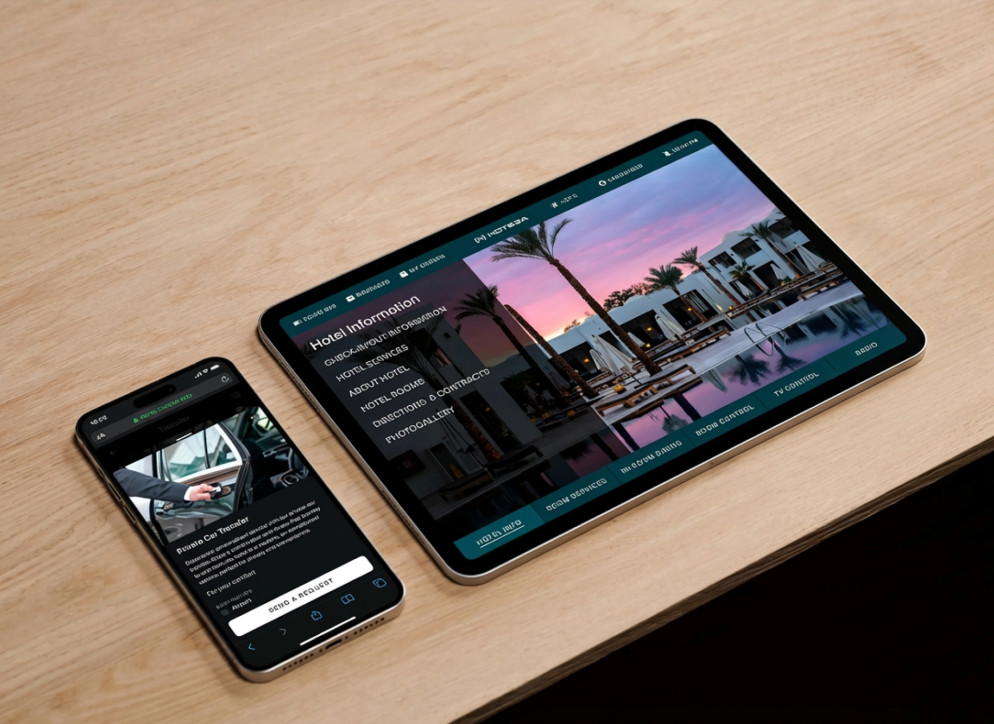
Tablets that succeed by being ordinary
Tablets in hotels usually do not fail due to hardware issues, but rather because they are not properly placed or introduced.
If tablets are shown as 'premium' devices, guests may be unsure about using them. But if they feel like a normal part of the room, guests use them more easily.
Placement matters.
Timing matters.
Content matters.
Guests use tablets when they are waiting, browsing, or deciding what to do, not because someone tells them to, but because the device fits naturally into their stay.
Once guests start using a tablet, they are more likely to make a purchase. But first, they have to actually use it.
This aligns with hospitality technology research that shows higher engagement when tools are perceived as helpful rather than promotional.
Guest apps that do less and perform better
The best guest apps often focus on just a few things.
They offer what is relevant to the hotel, not just what matches a feature list. Late checkout, transfers, tickets, events.
A few carefully chosen options work better than long menus that guests skip over.
Industry research backs this up: having lots of features does not add value — relevant features do.
Good hotel guest apps are built around what guests actually need, not just what is on a product plan.
Revenue that does not depend on staff effort
One big benefit of well-set-up hotel software is that it can help increase revenue without adding extra work for staff. Contextual upselling is a good example:
- A QR code in the room.
- A short list of add-ons that match the stay.
- Clear pricing.
- Simple confirmation.
Once set up, the system runs smoothly without needing daily reminders, scripts, or pressure on staff. This kind of reliability is worth more than having lots of complicated features.
Hotels do not need to keep tweaking their systems. They need tools that can handle daily use, staff changes, and busy times. This difference is what sets lasting revenue tools apart from short-term fixes.
Why configuration beats constant optimization
The misconception is that revenue-driven hospitality software requires constant attention. Most high-performing systems are configured once, reviewed periodically, and then operate independently.
The initial setup does the heavy lifting: clear content, relevant offers, and correct timing.
After setup, the system works quietly in the background.
This is especially important for hotels with limited digital resources. Revenue should not rely on daily manual input from already stretched teams.
Software that scales with the hotel
At Hoteza, we design for both realities. Our systems are designed to work immediately, with minimal configuration and no reliance on individual team members.
This basic level is crucial. Hotels should get value from their systems even if they are not always optimizing them.
At the same time, we intentionally allow for deeper configuration. When a hotel has a power user who understands guest flow, commercial priorities, and timing, the same tools offer additional possibilities. Better data capture. Cleaner upsell paths. Stronger post-stay communication.
The system stays the same, but the results get better.
We design for power users, but never require their involvement.
Why this matters in real hotel operations
Hotels operate under constant pressure. Occupancy fluctuates. Teams rotate. Priorities shift. Technology that requires ideal conditions to deliver value will not succeed.
Good hotel software should stay reliable during staff changes, busy times, and daily use. It should always provide basic value with little effort.
When a hotel is ready to advance, the system should reward that effort without adding complexity for others. Finding this balance is what makes hospitality technology truly effective.
The long-term view
As hotel technology evolves, the best solutions will not be the ones with the most features, but those that meet real hotel needs.
Systems that simply work are not the opposite of revenue-focused tools — they are the starting point.
With the right setup, the same tools can improve guest satisfaction, streamline operations, and increase revenue without complicating things.
That is the real opportunity for hotels.
Book a personalized demo today and discover the world of revenue-driven hospitality.
