30.07.2026
Hotel Guest Communication: Tools, Strategies & Best Practices
Discover how hotels can improve guest communication across every stage of the journey, from pre-arrival to post-stay, with the right mix of technology, automation, and human service.
Hotel guest communication has changed significantly. Guests still expect the warmth and personal attention that define good hospitality, but they also expect information to be available quickly and through the channels they already use.
A guest may want to confirm a check-in time over WhatsApp, ask for a restaurant recommendation from their phone, request extra towels without calling the front desk, or receive a reminder about their spa appointment. For hotel teams, handling all of these communications smoothly can be challenging when messages are spread across email, phone calls, messaging apps, guest apps, and in-room technology.
That is where a well-planned hotel guest communication strategy comes in.
Modern communication technology helps hotels stay connected with guests before, during, and after their stay, while giving staff a clearer view of requests and conversations. The goal is not to replace hospitality with technology. It is to remove unnecessary friction so hotel teams can spend more time on the interactions where a human touch matters most.
What Is Hotel Guest Communication?
Hotel guest communication includes every interaction between a hotel and its guests throughout the guest journey. This can range from a booking confirmation or pre-arrival email to a message about room readiness, a request for extra towels, a restaurant reservation, or a post-stay review invitation.
In practical terms, guest communication covers three main stages:
Pre-arrival communication, when the hotel prepares the guest for the stay.
In-stay communication, when guests need information, assistance, or services.
Post-stay communication, when the hotel follows up, collects feedback, and encourages future bookings.
The channels can vary. Email, SMS, WhatsApp, web chat, guest apps, in-room tablets, interactive hotel TVs, and AI assistants can all play a role.
The important part is not simply having more channels. It is making sure the experience is consistent across them.
Hotel Technology Report’s current overview of guest messaging platforms shows how the market has moved toward tools that centralize communication, automate routine interactions, and connect guest messaging with the wider hotel technology stack.
Why Guest Communication Matters in the Hotel Industry
Good communication has always been part of good hospitality. What has changed is the speed and flexibility guests expect.
A traveler arriving late at night may not want to call reception to ask whether the kitchen is still open. A family may prefer to request additional towels from their phone while getting ready for the beach. A business traveler might want to receive a digital receipt without stopping at the front desk.
These are small interactions, but there can be a lot of them.
When communication is handled manually, repetitive questions can take up significant front desk time. When information is hard to find, guests may call, send an email, visit reception, and then follow up again because they haven't received an answer.
Digital guest communication can make these interactions easier for both sides. Oracle Hospitality research has found that hotel guests show strong interest in using messaging apps for practical requests, including recommendations, extra toiletries, restaurant reservations, and room service.
For hotels, the opportunity goes beyond convenience. Communication can also become a channel for service, personalization, and revenue generation.
Hotel Guest Communication Across the Guest Journey
The best communication strategy changes depending on where the guest is in their journey. A message that is useful before arrival may be completely irrelevant once the guest is checked in.
1. Pre-Arrival Guest Communication
The relationship with a guest does not have to begin at the front desk.
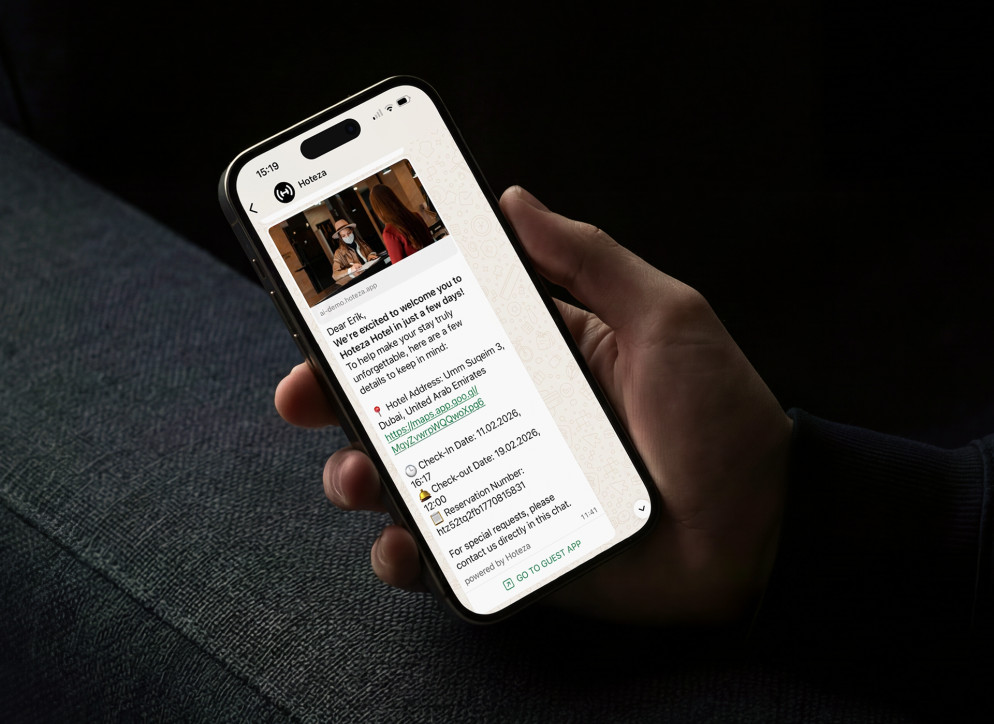
Once a booking is confirmed, hotels can use pre-arrival communication to answer common questions, set expectations, and help guests prepare for their stay.
A useful pre-arrival message might include:
Check-in and check-out information
Directions and parking details
Online check-in options
Information about hotel facilities
Restaurant and spa opening hours
Airport transfer options
Local recommendations
Room upgrades and additional services
Special requests or preferences
This is also a valuable moment for ancillary revenue. Guests who have already decided where they are staying may be interested in adding breakfast, a room upgrade, a transfer, a spa treatment, or another service.
The key is timing. A guest who receives a relevant offer at the right moment is more likely to consider it than someone repeatedly shown generic promotions.
Pre-stay automation can also reduce pressure on the front desk by answering common questions before the guest arrives. Hotel News Resource highlights pre-stay digital communication as a way to provide practical information while reducing unnecessary calls and questions to staff.
2. In-Stay Guest Communication
Once the guest arrives, communication becomes more immediate.
Guests may want to know where breakfast is served, how to connect to Wi-Fi, whether the spa has availability, what time the restaurant closes, or how to request additional amenities.
Traditionally, many of these questions would result in a phone call or visit to reception. Today, hotels can give guests several easier options.
A guest app can provide information and service requests from a smartphone. An in-room tablet can act as a digital concierge. Interactive TV can display hotel information, promotions, dining options, and entertainment. Messaging platforms can connect guests directly with hotel staff.
The result is not necessarily less interaction. It is a different type of interaction.
Instead of spending time answering the same question repeatedly, staff can focus on requests that genuinely require their attention.
3. Post-Stay Guest Communication
Communication should not stop at checkout.
A simple thank-you message can keep the relationship going after the guest leaves. Hotels can also use post-stay communication to request feedback, invite guests to leave a review, promote loyalty programs, or encourage a future direct booking.
Timing matters here too. A feedback request sent immediately after checkout is likely to feel more relevant than one that arrives several weeks later.
Post-stay communication can also help hotels identify service issues. If a guest indicates something went wrong, the hotel can respond directly instead of discovering the problem through a public review.
The objective is not to send more messages. It is to make each interaction useful.
What Tools or Technologies Can Assist With Hotel Guest Communication?
No single technology solves every communication challenge. Most modern hotels use a combination of tools, with each one serving a different purpose.
1. Unified Inbox
A unified inbox brings messages from different channels into one workspace.
Instead of asking staff to check several separate systems, hotels can centralize conversations from channels such as WhatsApp, SMS, email, web chat, or other messaging platforms.
This can be particularly useful for properties with busy front desks or multiple teams handling guest requests.
The advantage is visibility. Staff can see previous conversations, understand what the guest needs, and avoid asking the same questions again.
HotelTechReport’s guest messaging research highlights unified inboxes as a key capability hotels look for when evaluating guest communication software.
2. Automated Guest Messaging
Automation is useful for communication that follows a predictable pattern.
For example, a hotel can automatically send:
A booking confirmation
A pre-arrival message
An online check-in reminder
A room-ready notification
A welcome message
A restaurant promotion
A checkout reminder
A post-stay feedback request
The important distinction is between useful automation and message overload.
Automation should be based on the guest journey, booking information, timing, and preferences. A guest should receive the information they need when they need it, rather than a long series of generic messages.
Modern platforms can use triggers such as booking confirmation, online check-in, room assignment, arrival, service usage, and checkout to determine when to send communications. Hoteza Communication Hub, for example, supports customizable communication triggers across different stages of the guest journey.
3. AI Assistants and Hotel Chatbots
AI assistants are becoming another part of the hotel communication toolkit.
Their strongest use case is handling routine questions that have straightforward answers.
Guests might ask:
What time is breakfast?
Where is the spa?
What time does the pool close?
Is late checkout available?
How do I connect to Wi-Fi?
Can I book a restaurant table?
An AI assistant can provide an immediate answer without requiring a staff member to handle every interaction manually.
This does not mean every guest conversation should be automated. Complex complaints, sensitive situations, service recovery, and highly personalized requests still benefit from human involvement.
The most practical approach is often a combination of automation and human support. AI handles simple, repetitive questions, while staff step in when judgment, empathy, or decision-making is required.
The hospitality industry is already moving in this direction. The American Hotel & Lodging Association has highlighted hotel technology implementations using AI to streamline guest communications. At the same time, HotelTechReport reports that many guest messaging platforms now include AI capabilities for handling routine inquiries.
4. Guest Apps
A hotel guest app gives guests access to information and services directly from their mobile devices.
Depending on the property and technology, guests may be able to:
Browse hotel services
Request housekeeping
Order food and beverages
Book spa treatments
Make restaurant reservations
Request late checkout
Contact the hotel
Receive important notifications
Guest apps can also extend communication beyond the stay, starting before arrival and continuing after checkout.
The biggest advantage is convenience. Guests don't necessarily need to download a traditional app. Web-based guest apps can provide many of the same functions without requiring an installation.
5. In-Room Tablets and Interactive Hotel TVs
Not every guest wants to use their phone while relaxing in their room.
In-room technology provides another communication channel that is already available inside the hotel.
An in-room tablet can present hotel information, restaurant menus, spa services, room service, and guest requests in one place. An interactive TV can provide information, entertainment, promotions, and access to hotel services directly from the guest room.
These tools are also useful for communicating relevant offers. For example, a hotel might promote breakfast in the morning, a spa treatment during the afternoon, or room service around dinner time.
Hospitality Technology Next Generation documentation identifies guest room TVs and tablets as important guest-facing systems that can promote hotel services and deliver targeted messages based on guest information and preferences.
Where Hoteza Communication Hub Fits In
For hotels looking to bring guest communication together, Hoteza Communication Hub connects communication across the guest journey.
The platform supports automated and two-way communication through channels including email, WhatsApp, and push notifications, and connects with other guest-facing touchpoints such as in-room TV.
The idea is simple: instead of treating every communication channel as a separate activity, hotels can manage communication as part of one connected guest journey.
Before arrival, the hotel can send useful information, online check-in reminders, or relevant upgrade and transfer offers.
During the stay, communication can support service requests, information, promotions, and personalized messages.
Before departure and after checkout, the same system can support checkout reminders, feedback requests, and future engagement.
Hoteza Communication Hub also supports segmentation and triggers based on guest information, preferences, occasions, and journey milestones. This gives hotels more control over what is communicated, to whom, and when.
The platform can also work alongside Hoteza AI Concierge, allowing routine guest questions to be handled automatically while keeping communication connected to the wider Hoteza ecosystem.
Best Practices for Hotel Guest Communication
Technology is only useful when the communication strategy behind it makes sense. A few principles can help hotels get more from their guest communication tools.
Keep Communication Relevant
Guests do not need every piece of information the hotel has.
Segment your audience and use booking information, preferences, stay dates, and guest profiles to make communication more relevant.
A family traveling with children may appreciate information about kids’ activities. A business traveler may care more about breakfast hours, Wi-Fi, and meeting facilities.
Choose the Right Channel
Not every message needs to be sent everywhere.
Email works well for detailed information. Messaging works well for quick questions and time-sensitive updates. In-room technology is useful for services and information guests need while they are on property.
The goal should be channel flexibility, not channel overload.
Give Guests a Clear Way to Respond
Communication should not be one-way.
If a hotel sends a message saying that guests can request a service, the process should make it easy to actually make that request.
Two-way messaging allows guests to ask follow-up questions and gives staff a clearer picture of what needs to happen next.
Automate the Repetitive, Not the Personal
Automation is most valuable when it removes repetitive work.
Use it for reminders, confirmations, FAQs, and routine service information. Keep human involvement where the situation requires empathy, flexibility, or judgment.
Make Timing Part of the Strategy
A good message at the wrong time is still a bad guest experience.
Think about what the guest is likely to be doing at each stage of the journey. A pre-arrival message can help someone prepare for their trip. A breakfast promotion makes more sense in the morning. A spa offer may work better when the guest is already on property.
Hoteza Communication Hub allows hotels to set timing rules around specific times, actions, dates, and guest journey milestones, helping properties coordinate communication with the guest’s actual stay.
Keep the Human Touch
Technology should support hospitality, not make it feel robotic.
A personalized welcome message, a thoughtful response to a special request, or a quick intervention when something goes wrong can have a much greater impact than another automated notification.
The strongest hotel communication strategies combine both. Technology provides speed and consistency. People bring empathy, judgment, and genuine hospitality.
The Future of Hotel Guest Communication
Guest communication is becoming less about individual messages and more about connected experiences.
Guests are already comfortable communicating with businesses through messaging apps, mobile devices, and digital assistants. At the same time, hotel teams need tools that help them manage growing expectations without adding more administrative work.
The next step is not simply adding another communication channel. It is connecting the channels hotels already use and making sure the right information follows the guest throughout the journey.
For hoteliers, that means viewing communication as part of operations, guest experience, and revenue strategy.
A message can answer a question. It can prevent a phone call. It can help a guest discover a service. It can generate an upsell. And, when handled well, it can make a guest feel that the hotel is paying attention.
That is what effective hotel guest communication should ultimately achieve: making it easier for guests to get what they need while giving hotel teams more time to deliver the hospitality that technology cannot replace.
Frequently Asked Questions About Hotel Guest Communication
What is hotel guest communication?
Hotel guest communication refers to all communication between a hotel and its guests before, during, and after a stay. This includes emails, SMS, WhatsApp, guest apps, web chat, in-room tablets, interactive TVs, AI assistants, and direct communication with hotel staff.
What are the main stages of guest communication?
The three main stages are pre-arrival, in-stay, and post-stay communication. Each stage has a different purpose, from preparing guests for arrival to providing services during the stay and maintaining the relationship after checkout.
What technologies can hotels use for guest communication?
Hotels can use unified inboxes, automated messaging platforms, guest apps, AI assistants, chatbots, in-room tablets, interactive hotel TVs, and messaging channels such as WhatsApp and SMS. The best combination depends on the hotel’s size, service model, guest profile, and existing technology stack.
How can AI improve hotel guest communication?
AI can answer routine guest questions, provide information 24/7, support multiple languages, and reduce repetitive requests that hotel staff handle manually. Human employees should remain involved when a request requires empathy, judgment, or service recovery.
How can hotels improve guest communication?
Start by mapping communication across the entire guest journey. Then identify repetitive questions and manual processes that can be automated, centralize guest conversations where possible, personalize messages using available guest data, and make it easy for guests to move from receiving information to taking action.
How does guest communication increase hotel revenue?
Guest communication can introduce relevant services and offers at moments when guests are most likely to use them. Targeted communication can promote room upgrades, transfers, breakfast, spa treatments, dining, late checkout, and other ancillary services. The key is to make offers useful, not intrusive.
Improve Hotel Guest Communication with Hoteza
Effective guest communication is not about sending more messages. It is about making every interaction easier, more relevant, and more useful.
Hoteza connects communication across the guest journey, helping hotels automate routine messages, engage guests through multiple channels, promote services, and give staff better visibility into guest interactions.
With Hoteza Communication Hub, Guest App, HotPad, Hoteza TV, and AI Concierge working together, hotels can create a more connected communication experience from booking to checkout.
Want to see how Hoteza can support your hotel’s guest communication strategy? Get in touch with our team at hello@hoteza.com.
