20.08.2026
The Staffless Hotel: Challenges and Opportunities from A to Z
Explore how staffless hotels are reshaping hospitality through automation, from mobile check-in and digital keys to robots and remote guest support.
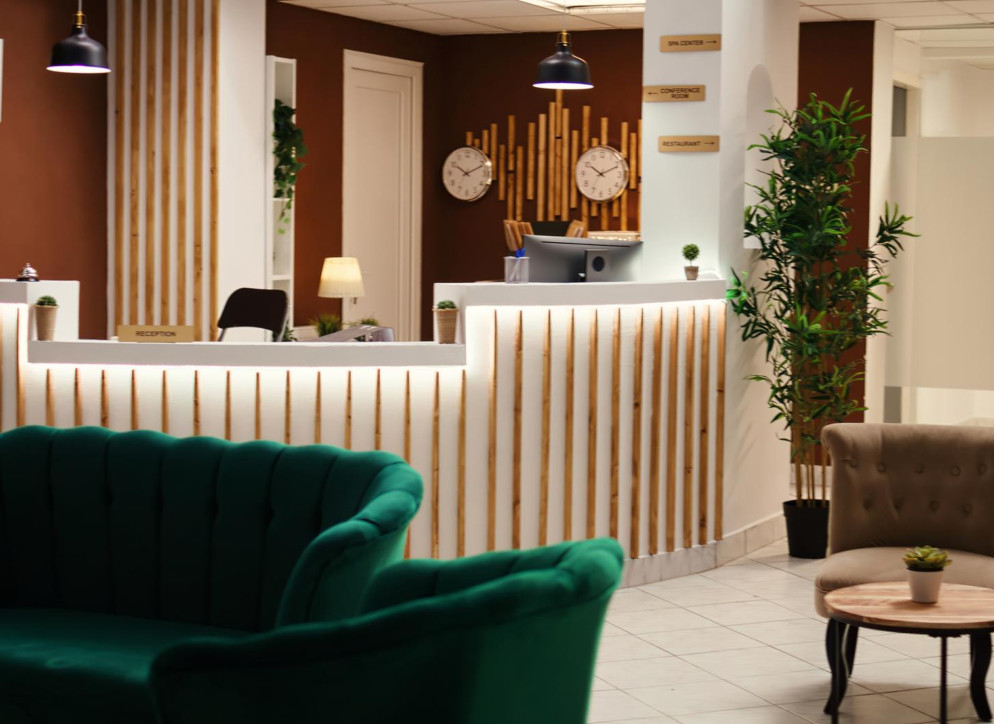
Let's be honest: the front desk as we know it is disappearing, and this is not a bad thing. Today, a guest can arrive at a property, get the key on their phone before they even step out of the taxi, and never wait one minute in a lobby. Below their feet, robots are already cleaning corridors and bringing towels to the door. Ten years ago this sounded like a concept from a tech expo. Now it is simply how some hotels work.
In this article, I want to walk through what the staffless hotel actually looks like, be honest about the challenges it brings for guests, and then talk about why, for owners, PMCs, and chains, this is one of the biggest opportunities the industry has seen in years. And at the end - a question worth thinking about, not a technical one, but a human one.
What does a staffless hotel of the future actually look like?
Imagine the whole guest journey, from arrival to checkout, with technology doing most of the heavy lifting:
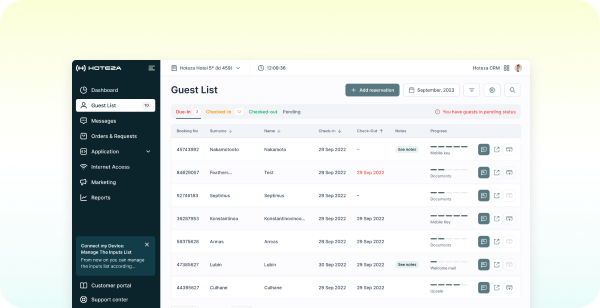
Staffless check-in. ID verification, payment, registration — all done on the guest's own phone or on a kiosk, before they reach the room. No queue, no waiting for someone to type your passport number into a PMS or hand you a paper form to sign.
Mobile key instead of plastic card. The room credential lives in Apple Wallet or Google Wallet or a mobile app, delivered the moment the ID check and payment clear, and removed automatically at checkout. No card to cut, no line at the desk because someone lost their key.
Robo-chefs. Automated kitchen units preparing standard menu items: burgers, pizza, breakfast basics, with almost the same quality and timing, at 3 am as at 3 pm, with no kitchen team required to be on shift around the clock. In-room dining delivered by delivery robots straight to the room.
Housekeeping robots. Vacuum robots, disinfection units, delivery robots bringing extra towels or a charger to the door — all coordinated by software instead of a floor supervisor walking the corridor with a clipboard. Sounds like a crazy thing - but it's coming.
Each of these pieces already exists today, somewhere. Together, they create a property that can run a full guest cycle smoothly, consistently, and without depending on which staff member happened to be on shift that day.
The challenges, and why they are solvable
Of course, this kind of change does not come free of friction. It is honest to say guests may notice gaps, especially early on. But it is just as honest to say: none of these are permanent problems. They are simply the things a good operator needs to design around.
The personal touch. Some guests still want to ask a real person for a restaurant recommendation, or want someone to notice they had a long flight. The answer is not to remove this—it is to move human attention to where it actually matters, instead of spending it on typing forms.
Technical glitches. A kiosk that freezes, a key that does not provision fast enough, Wi-Fi that goes down at the wrong moment. This is a real risk, but it is also an engineering problem the industry is already solving — banks and airlines automated far more complex processes years ago, with redundancy and offline backup built in. Hospitality is catching up fast.
Who do I call when something goes wrong? A guest with a broken air conditioner at 2 am should never feel alone. The best staffless properties pair automation with a live remote support team, often reachable faster than walking down to a front desk would have been.
Where does feedback go? People assume automation removes the chance to complain or to say thank you. In practice, digital check-in and app-based flows can capture far more feedback than a rushed conversation at a desk ever did: guests are often more honest in a quick in-app rating than face-to-face.
Trust with personal data. Guests give their ID, their face, and their payment details to a screen. This deserves to be taken seriously, but with a clear, transparent explanation of how data is protected, this becomes a strength of the brand, not a weakness.
Not everyone is equally comfortable with technology. Older guests, guests who do not speak the local language, guests with disabilities — a good staffless design thinks about all of them from day one, not as an afterthought.
None of this is a reason to slow down. It is simply the list of things worth getting right.
Where is the real opportunity for owners and chains?
From an operator's side, the case is very strong, and getting stronger every year.
Standardized openings. A new hotel can launch on day one with the exact same guest experience as a property that has been open for ten years — no long ramp-up period training a new team.
Lower staffing costs. Front desk, night audit, parts of housekeeping — these costs go down, and that money can go into better rooms, better technology, or simply better margin.
More guests served with the same resources. No staffing bottleneck during a busy check-in rush. The system does not get tired or slow down at 6 pm on a Friday.
Consistency around the clock. A well-built automated flow doesn't have a bad day, doesn't call in sick, and delivers the same experience at 3 am as at 3 pm.
Data from every step. Each digital touchpoint — check-in, key usage, service requests — creates data that a traditional front desk never captured. This data becomes the base for smarter pricing, smarter personalization, better decisions.
Easy to scale. For chains, once the flow works well in one property, it can be copied to the next one with very little local adjustment. This is a real advantage when you are opening ten properties a year instead of one.
For owners, this is not a gimmick or a trend to wait out. It is one of the clearest ways to grow margin and grow the brand at the same time.
Staffless does not have to mean empty
Another opportunity is easy to overlook: staffless hotels can make entirely new types of properties commercially viable. Think about a small hotel in a remote destination, a property with only 20 or 30 rooms, or a seasonal hotel that struggles to justify a full team during quieter months. Traditionally, these properties still need someone at reception, someone available at night, and enough staff to cover the basics, even when only a handful of guests are in the building. That fixed cost can make the business difficult to operate profitably.
Automation changes the equation. A smaller team can manage more rooms, while remote support can cover moments when an on-site employee isn't necessary. A hotel can stay open later, operate year-round, or offer 24/7 arrivals without physically having someone behind a desk 24 hours a day.
It also gives guests more flexibility. A traveler arriving at midnight should not have to plan their entire journey around reception hours. Someone leaving before sunrise should not have to find a staff member to check out. And a guest who wants complete privacy should be able to have it.
That does not mean every hotel should become completely staffless. In fact, the most interesting model may be somewhere in between: fewer people performing repetitive operational tasks, and more people available when their presence genuinely adds value. The technology changes where, when, and why we need them.
Are we ready — not technically, but morally?
Here is the interesting part. Technically, we are ready. Mobile key works. Automated check-in works. Kitchen robots and cleaning robots work well enough today. The real question the industry needs to answer is not "can we build this" — it is "how do we use it well."
And this is actually an exciting question, not a scary one. Every industry that automated its repetitive tasks did not lose its human side, it moved the human side somewhere more useful. Airlines automated ticketing, but they did not remove the cabin crew. Banks automated transactions, but relationship managers still exist, doing work that actually needs a person. Hospitality can do the same, maybe even better.
A concierge who no longer processes paperwork has more time to actually know the city and recommend the right restaurant and a truly unique experience. A guest-services person who is not handing out key cards all day can become a personal assistant to the one guest standing in front of them who needs something special. Technology, used the right way, does not compete with the human side of hospitality, it protects it by clearing away everything that used to take time away from it.
So the hotels that will win are not the ones that automate everything just because they can, and not the ones that resist automation out of fear either. They will be the ones who are deliberate, who use technology to free their people for the moments that actually matter, and who make good hospitality something more guests can enjoy, more reliably, than ever before.
