06.08.2026
Digital Hotel Keys: How Mobile Access Is Changing the Guest Experience
Digital hotel keys are changing the way guests access their rooms. Discover how mobile and wallet-based access can make arrivals faster, reduce friction, and become part of a more connected guest journey.
The way guests access their hotel rooms is changing.
For decades, the key card has been a familiar part of the hotel experience: check in at reception, receive a plastic card, keep it safe throughout the stay, and return it at check-out. It is simple and familiar, but it also creates a small point of friction in an increasingly digital guest journey.
Today, guests can book their stay from a smartphone, complete online check-in, receive hotel information digitally, make payments and communicate with staff without visiting the front desk. Naturally, room access is becoming part of that same digital experience.
Digital hotel keys allow guests to use their smartphones as room keys, giving them a more convenient way to access their rooms while helping hotels create a faster, more connected arrival experience.
But digital keys are about more than replacing a piece of plastic. When connected to mobile check-in and other guest-facing technologies, they can become an important part of a seamless hotel journey.
What Is a Digital Hotel Key?
A digital hotel key, also known as a mobile key, allows a guest to use a smartphone or another supported device to unlock a hotel room instead of relying on a traditional key card.
Depending on the solution and hotel infrastructure, digital access can work through technologies such as Bluetooth Low Energy (BLE), NFC or smartphone wallet platforms.
The guest receives their digital credential after completing the required check-in process. Once activated, the smartphone communicates with the hotel’s compatible door-lock system, allowing the guest to access their room without carrying a physical key card.
Hoteza Mobile Key, for example, enables guests to use their smartphone for keyless room entry through the Hoteza Guest App. The solution is designed to work as part of the wider digital guest experience rather than as a standalone door-opening function.
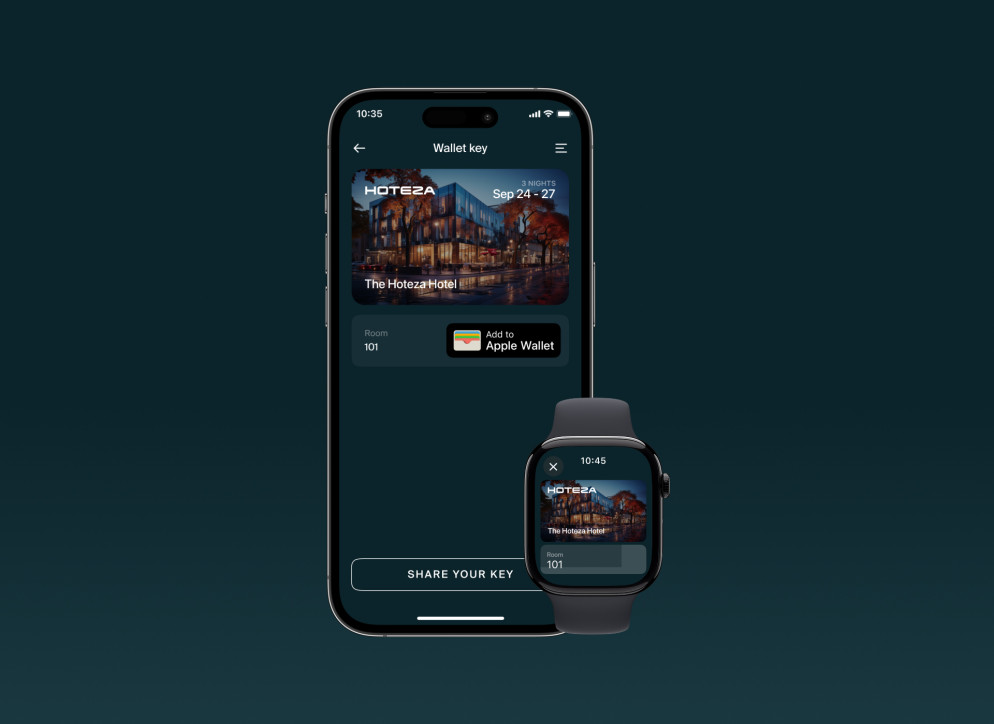
More recently, hotels have also started adopting wallet-based digital keys. Instead of requiring guests to download a dedicated hotel application, credentials can be stored in Apple Wallet or Google Wallet, making access more familiar and reducing the number of steps required from the guest. Hoteza Wallet Keys are designed around this approach and can be integrated with its online check-in experience.
Why Are Hotels Moving Toward Digital Keys?
The growing interest in digital hotel keys is part of a broader shift in guest expectations.
Travelers are already accustomed to using their smartphones for boarding passes, payments, loyalty cards, reservations and communication. The smartphone has become a central tool throughout the travel journey, so using it to access a hotel room is a natural extension.
There is also growing evidence of guest interest. Hilton reported that 63% of respondents in its 2025 Trends research wanted to use a digital room key. The company also reported nearly 14.3 million Digital Keys downloaded between January and August 2024.
At the same time, digital keys can address several operational challenges for hotels.
They can help reduce queues at reception, minimize the need to issue replacement cards and give guests more flexibility around arrival. When combined with online check-in, they can also allow eligible guests to move from pre-arrival directly to room access.
The result is not simply a different key. It is a different arrival experience.
How Do Digital Hotel Keys Work?
Although the exact process varies depending on the technology and hotel’s access-control system, the guest journey typically follows a few basic steps:
1. The guest completes check-in
Before receiving a digital key, the guest completes the hotel’s required check-in and identification process.
With a connected online check-in solution, this can happen before the guest arrives at the property. Hoteza mobile check-in solution supports digital identity verification, payments and other pre-arrival steps.
2. The digital key is issued
Once the guest is cleared for arrival, the digital credential is made available on their smartphone.
Depending on the hotel’s setup, this may be through a hotel app, a web-based experience or a native smartphone wallet.
3. The guest approaches the door
The smartphone communicates with the compatible hotel lock using the supported access technology.
The guest can then unlock the room without needing to take a physical key card out of their wallet or bag.
4. Access ends after the stay
Digital credentials can be configured to correspond with the guest’s reservation and access period. This allows hotels to manage access according to the stay rather than relying on a physical card that must be collected or returned.
The exact implementation depends on the hotel’s lock system, integrations and chosen digital-key technology.
Digital Keys vs. Traditional Key Cards
Traditional key cards are unlikely to disappear from every hotel overnight — and they don’t necessarily need to.
Different guests have different preferences. Some travelers may prefer a physical card, while others will happily use their smartphone for every part of their stay.
The advantage of digital access is that it gives hotels another option.
| Physical card required | Smartphone or supported device |
|---|---|
| Usually collected at reception | Can be issued digitally |
| Can be lost or damaged | Stored on the guest’s device |
| Requires physical card production | Reduces dependence on plastic cards |
| Often separate from digital check-in | Can be connected to online check-in |
| Guest carries another item | Uses a device they already carry |
The most effective approach is therefore not necessarily to eliminate physical keys completely. It is to give guests a choice while making the digital option as simple as possible.
5 Benefits of Digital Hotel Keys
1. A More Convenient Guest Experience
The biggest benefit is straightforward: guests can use something they already carry with them.
There is no need to search through a wallet for a key card or return to reception because a card has stopped working.
For guests who prefer a contactless experience, mobile access can make arrival and movement around the property much easier.
2. Faster, More Flexible Arrivals
When digital keys are connected to online check-in, eligible guests may be able to complete much of the arrival process before reaching the hotel.
Instead of:
Arrive → queue → check in → receive key → go to room
the journey can become:
Check in online → receive key → arrive → go to room
This can be especially valuable during busy arrival periods, when reducing even a few minutes at the front desk can make a noticeable difference to both guests and staff.
3. Less Pressure on the Front Desk
A large proportion of front-desk interactions are routine.
Issuing a room key is one of them.
Digital access can reduce the number of guests who need to visit reception simply to collect a key card, allowing staff to spend more time on interactions where human service really matters.
This does not mean removing the front desk from the guest experience. It means giving hotel teams more time to focus on the guests who actually need their help.
4. Fewer Physical Key Cards
Digital keys can also contribute to hotels’ sustainability efforts by reducing reliance on disposable plastic key cards.
The environmental impact will vary depending on the property’s existing key-card usage and digital-key adoption, but replacing some physical credentials with digital ones can help reduce material consumption.
For large properties, even small changes to everyday operational processes can add up over time.
5. A More Connected Digital Journey
Perhaps the biggest opportunity is not the digital key itself.
It is what happens when the key becomes connected to other hotel technologies.
A guest might complete online check-in, verify their identity, sign registration documents, receive a digital key, communicate with the hotel and request services — all through connected digital touchpoints.
This is where digital access moves beyond a technology feature and becomes part of a guest journey.
Digital Keys and the Rise of Wallet-Based Access
One of the most interesting developments in mobile hotel access is the move toward Apple Wallet and Google Wallet.
The idea is simple: instead of asking guests to download another app just to access their room, hotels can provide a digital credential that lives inside a wallet application guests already know.
This can reduce friction during the setup process.
Hoteza Wallet Keys allow hotel guests to store room access credentials in Apple Wallet or Google Wallet as part of the digital check-in experience. Depending on the hotel’s access-control infrastructure, wallet-based access can also extend to areas such as elevators and other restricted spaces.
This approach reflects a broader principle in hospitality technology:
The best digital experience is often the one that asks the guest to do the least.
Do Hotels Need to Replace Their Existing Door Locks?
This is one of the most important practical questions when considering digital keys.
The answer depends on the hotel’s existing access-control infrastructure.
Digital-key solutions need to communicate with compatible electronic locks and access systems. Some properties may already have suitable infrastructure, while others may need upgrades or integrations before introducing mobile access.
That means implementation should start with an assessment of the existing lock system, not simply choosing a digital-key provider.
Hoteza supports mobile-key integrations with hotel access-control technologies and offers solutions that can work alongside other elements of the hotel’s digital infrastructure.
For hotel operators, this is an important distinction: going digital does not necessarily mean rebuilding the entire technology stack.
What Happens If a Guest’s Phone Dies?
A digital-first hotel experience still needs to account for real-world situations.
Phones run out of battery. Guests forget devices. Some travelers simply prefer physical keys.
That is why digital access should be treated as an additional option rather than a requirement for every guest.
Hotels can continue supporting traditional key cards where necessary while offering digital access to guests who prefer it.
The goal is not to force every guest into the same experience.
The goal is to give each guest the simplest option for their stay.
Digital Keys Are Only One Part of the Guest Journey
A digital key is useful on its own. But its real potential appears when it is connected to the rest of the guest experience.
Consider the journey:
Before arrival: The guest receives pre-arrival communication and completes online check-in.
During check-in: Their identity and registration details are processed digitally.
Room access: The guest receives a digital key and goes directly to their room.
During the stay: The same digital environment can provide hotel information, service requests, bookings and communication.
At check-out: The guest can complete the departure process digitally.
This creates a much more consistent experience than having separate technologies for every stage.
Hoteza’s Guest Journey platform brings together mobile check-in, digital keys, guest communication, the Guest App and other guest-facing solutions, allowing hotels to connect different stages of the stay.
The Future of Hotel Access Is About More Than Going Keyless
Digital hotel keys are often presented as a way to replace plastic key cards.
But that is only part of the story.
The bigger opportunity is to rethink what hotel arrival should feel like.
Guests don’t necessarily want more technology. They want fewer unnecessary steps.
They want to arrive without waiting in line when they don’t need to. They want access to their room without searching for a card. They want hotel services to be easy to find and simple to use.
And hotel teams want technology that reduces repetitive work rather than adding another system to manage.
Digital keys can help bring those expectations together.
The key itself may be digital, but the real goal is much simpler: a hotel stay that feels effortless from the moment the guest arrives.
Ready to Make Hotel Access More Seamless?
Hoteza Mobile Key and Wallet Keys help hotels create a more convenient, connected arrival experience by bringing room access into the guest’s smartphone journey.
Combined with mobile check-in, digital registration and other Hoteza Guest Journey solutions, digital access can become part of a seamless experience that works for both guests and hotel teams.
Explore Hoteza Digital Keys and discover how mobile access can fit into your hotel’s guest journey.
